
sow-enterprise-express
Proposed Solution
Software Modules in Scope
A list of modules is included in the Order Form under section 3. These modules are considered in scope and any modules not listed would not be included within the scope of this project.
Services Approach: Express Implementation Methodology
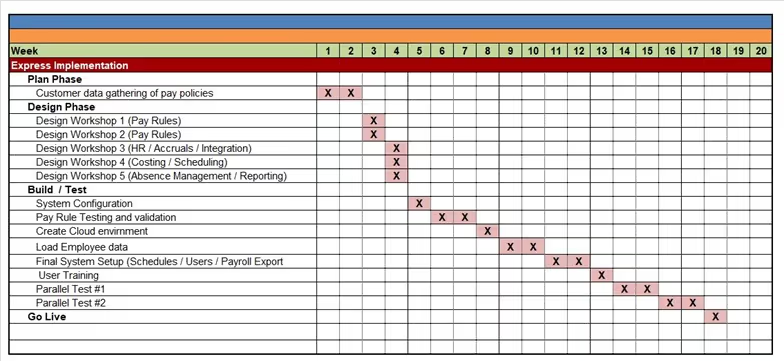
The Synerion Project Manager will lead the client project team through several design workshops that will map client requirements to Synerion solution features. Once the design sessions are completed Synerion will provide a testing environment and test reports for pay rules, to allow the customer to validate that the Synerion solution is configured to support their requirements.
Once validated the customer environment will be moved to deployment, final setup, final testing, and training tasks.
Sample Schedule
Express Project Scope and Assumptions:
This Statement of Work identifies the assumptions made to estimate the Professional Services hours required to implement the solution. If your requirements differ from the Basic Solution Assumptions please ensure this is captured within the Order Form prior to executing the agreement to ensure an accurate services budget is included.
If the solution or assumptions defined in this document change, Synerion and Client will review and adjust the project scope and budget accordingly through standard Synerion change control procedures.
Basic Solution Assumptions
Number of employee: As per order form
Number of Sites: <10
Number of Countries: 2 or less (Canada and USA)
Number of States/Provinces :<10
Number of Languages for training: 1- English
Languages required for system configuration:1- English
Employee interface: 1 or less
Payroll Interface: 1 or less
Other interface: 0
Additional or Special In-Scope Elements
If the Client has critical requirements that are required to make this project successful, it must be included in the Synerion Order Form to be considered in scope.
Additional Assumptions
- Customer will assign a Project Manager who will be the single point of contact with the Synerion Project Manager.
- Custom Reports unless specified in this document, are out of scope.
- Customer is responsible for developing their workforce management policies.
- Customer is responsible for managing communication and change for their organizations.
- Customer’s project team will adhere to the project timeline and responsibilities.
- Customer agrees to participate in and deliver all required documentation for the Design Workshops within the agreed upon time-frame in order to meet the agreed go-live date.
- Customer is committed to meeting project timelines. Delays in the project can lead to a change order for additional project management hours.
- Synerion has a robust rules engine built up over more than 35 years in the business. There are tens of thousands of possible rule combinations that Synerion supports in regions around the globe. In addition to canned functionality, Synerion also has the ability to program custom rules that are configured through advanced configuration. This statement of work and quotation assumes that all of the customer’s rules are supported through our normal rules engine unless otherwise specified in this section. If you have questions about whether or not a specific rule would be supported for your organization, please send the details to Synerion for evaluation.
Testing & Pre-Go-Live Validation
- During the testing phase of the project Synerion will produce test case documentation to help customers understand the pay rule and system configuration.
- Customer is responsible for validating that the system configuration and payroll results meet their business, policy, and compliance requirements.
- Customer and Synerion agree that the system configuration will be tested and validated prior to go-live using test activities and/or non-production payroll cycles (including trial or parallel payroll where applicable).
- Customer will provide representative test data, review and compare calculated results against expected outcomes, and confirm completion of validation prior to go-live.
Go-Live, Configuration Acceptance &Transition to Support
- After completion of pre-go-live testing and validation, Customer will process two (2) consecutive live payroll cycles using Synerion for time and/or labor management (the “Live Confirmation Period”).
- Assuming there are no open issues that prevent accurate payroll processing at the end of the Live Confirmation Period, the configuration used in those live payrolls, as previously validated by Customer, will be considered the accepted baseline. At that point, the Project will transition from Implementation to Support. Any further changes to rules, configuration, or requirements will be handled either through Support (refer to SLA for more details) or as a separate change request.
Issue Resolution During Testing & Live Confirmation
- During pre-go-live testing and validation, Synerion will work with Customer to resolve issues that impact correct payroll calculations, within the scope of this Statement of Work.
- Issues identified during the first two live payroll cycles that relate to the agreed configuration will also be addressed as defects where they prevent accurate payroll processing.
- Changes that reflect new requirements, policy changes, or preference changes (rather than defects) may require additional effort and will be handled through the change management process.
Project Scheduling, Pauses, and Remobilization
- Customer-driven Delays and Pauses
If Customer delays activities, decisions, or deliverables required from Customer for more than ten (10) consecutive business days, the Project may be considered “on hold” at Synerion’s discretion.
- Impact on Timelines and Estimates
The Synerion SOW includes the use of the project management team during the timeline provided. When a Project is placed on hold at Customer’s request or due to Customer delays, Synerion may not be able to keep to the original timeline. Upon reactivation, Synerion may re-plan the Project and provide updated timelines and, if applicable, an updated estimate of remaining effort.
- Remobilization Effort
A pause in the Project may require additional project management and consulting effort for remobilization (for example: re-planning activities, re-reviewing configuration and design decisions, onboarding or re-aligning resources). This remobilization effort is out of scope of this Statement of Work and may be billed on a time-and-materials basis or handled through a change order. - Resource Availability
Following a Customer-driven pause, Synerion cannot guarantee the same project team members or the same resource allocation as originally planned. Resource assignments will be based on availability at the time of reactivation.
Deployment Model & Wave-Based Rollouts
- Deployment Model Assumption
The effort and fees in this SOW are based on a single deployment (“Initial Deployment”) and go live for all in scope employee groups, locations and business units, and do not include staged or wave-based deployments.
- If the Customer requires a wave-based or phased deployment (for example, separate go-lives by site, division, union group; or repeated design, configuration, testing, training, and cutover activities for different groups at different times), this work will require a separate change order and/or a separate Statement of Work. Support for subsequent deployment waves, including rollout planning, configuration extensions, data migration, and hypercare for newly onboarded groups, will be scoped and priced separately.
- Adding New Groups After Initial Deployment
Onboarding additional employee groups, locations, business units, or legal entities after the Initial Deployment (including any new or modified rules, pay policies, or integrations required for those groups) is not included in this SOW and will require a change order.
Interfaces
This implementation includes 1 or less interfaces. When Synerion provides data via an interface to a non-Synerion system, Synerion will provide an export file according to customer specified file layouts and data content. It is the responsibility of Client or the 3rd party to import that data file to update the appropriate database. In the case of Employee Imports, it is the responsibility of Client to make the source data available to Synerion in the agreed upon format.
Training Services
Training environment and training materials for initial training will be provided by Synerion.
Professional Services Engagement Policies
General
- All Professional Services work will be conducted during normal business hours, 8:30 – 5:00 EST Monday through Friday.
- Synerion requires notification for canceling or rescheduling of Synerion personnel. The customer will be charged for failing to meet the following notification requirements:
- Within 48 hours – 50% of planned charges are invoiced for scheduled work.
- Within 24 hours – 100% of planned charges are invoiced for scheduled work.
Change Order Process
- Changes to the signed Statement of Work will be managed by the Synerion Project Manager and result in initiating the Change Order process.
- A change to project deliverables, allocated time or schedule initiates the Change Order process.
- The last authorized Statement of Work, including any previously approved Change Orders will prevail until amended by a subsequent approved Change Order.
Travel
- The customer is responsible for all travel costs including travel time, mileage charges, and all other travel expenses.
Unethical Behavior
Employees, vendors, partners, and various other interested parties can anonymously report any form of unethical or immoral behavior by calling the office number (877) 816-8463 ext 425 that may include, but is not restricted to:
- Breach of a legal obligation (e.g. safety procedures/obligations of the organization)
- Malpractice and unethical conduct
- Deliberate actions that put someone’s health and safety in danger
- Potential breach of statutory requirements and/or a criminal offense
- Breach of the organization’s audit, code of conduct, or other applicable policies/regulations.
Any party who raises concerns about unethical or immoral behavior, whether the incident has occurred, occurs, or would occur, is subject to the jurisdictional public disclosure and protection acts. The identity of all disclosers and witnesses will be protected from victimization. Information created or obtained in the course of an investigation into a disclosure is protected under the relevant jurisdictional data protection act. While parties are not encouraged to raise concerns anonymously as it hinders the investigation process and credibility of information, they may do so if it enables them to speak openly. All concerns will be addressed fairly and in an appropriate manner, given that they are within the terms highlighted above. The party will be informed of the progress of the information and the timescale; however, confidentiality may restrict the details of the investigation and any disciplinary actions are taken.
Ready to get started?
Book a Demo Today